How long do spacers take to put in at a West Concord pediatric dentist?
A plain look at the fitting visit, the placement visit and the checkups that keep a space maintainer doing its job.
How long do spacers take to put in?
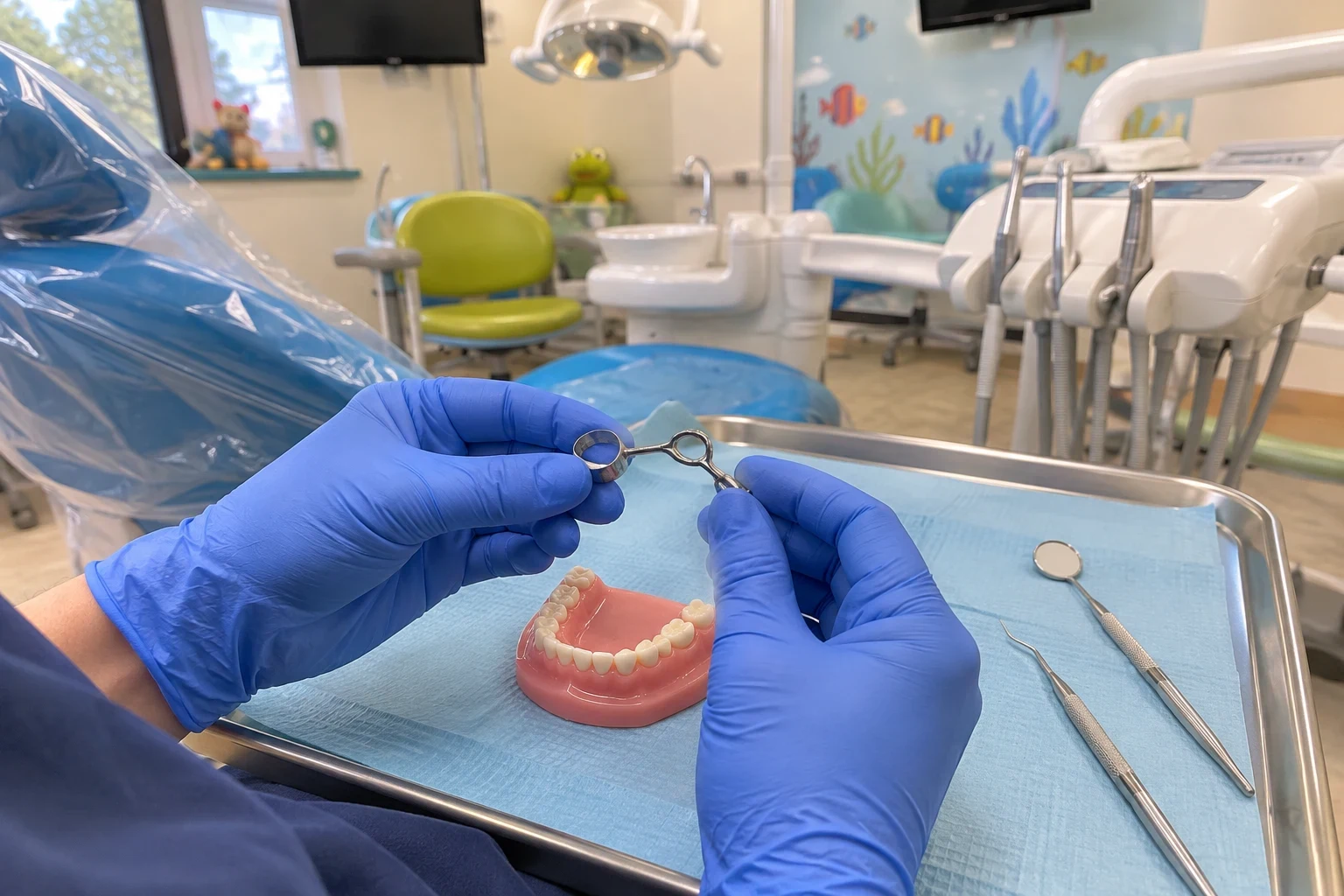
Cementing a fixed spacer, which dentists call a space maintainer, usually takes about 15 to 30 minutes in the chair. Most kids need two visits: one to size the band and take an impression or scan, and a second to cement the finished appliance once the lab returns it. Removable spacers follow a similar two-visit pattern.
What happens at the first visit
The first appointment is about measuring, not attaching. We look at the gap left by the lost or removed baby tooth, check the neighboring teeth and often take an X-ray to see where the permanent tooth sits under the gum and how far along it is. That tells us whether a spacer is needed at all and which design fits.
Next we fit a thin stainless steel band, or sometimes a crown, onto the molar beside the gap. A band that is too loose lets food and plaque collect underneath, so we try sizes until one seats snugly. Then we take an impression or digital scan with the band in place. That record goes to a dental lab, where the wire loop or arch is bent and soldered to match your child's mouth.
For most kids this visit is quick and needs no numbing. Some feel pressure as the band is pushed down, which fades within a minute or two.
What happens when the spacer is cemented
When the appliance comes back from the lab, we try it in first to confirm the loop rests lightly against the tooth on the far side of the gap without pressing into the gum. If it needs a small adjustment, we make it before anything is cemented.
We then clean and dry the anchor tooth, fill the band with a dental cement such as glass ionomer, and press it into place. Glass ionomer bonds to tooth enamel and releases a little fluoride, which helps protect the tooth under the band. Excess cement is cleared away, and we check the bite so nothing catches when your child chews.
The cementing step itself is often the shortest part of the visit. Most of the time goes to fitting, checking and explaining care to you and your child before you leave.
- Try-in and fit check
- Cleaning and drying the anchor tooth
- Cementing the band and removing extra cement
- Bite check and care instructions for parents
Why the type of spacer changes the timeline
Not every space maintainer is built the same way, and the design affects how long the process takes from start to finish.
A band-and-loop is the most common fixed design for one missing back baby tooth. A lingual holding arch runs along the inside of the lower teeth and is anchored to molars on both sides, so it takes a little longer to fit. A distal shoe is used when a first permanent molar has not come in yet; its metal extension guides that molar into place and may be placed soon after an extraction, which can make it a more involved visit. Removable spacers look like a small retainer with a plastic plate and are fitted and adjusted rather than cemented.
Timing after a tooth comes out matters too. Neighboring teeth can start drifting into an open space within weeks to months, so if your child is having an extraction we usually plan the spacer at the same time rather than waiting.
- Band-and-loop: one missing back tooth, one anchor band
- Lingual holding arch: several missing lower teeth, two anchor bands
- Distal shoe: guides an unerupted first permanent molar
- Removable spacer: plastic plate with wire clasps
How to care for a spacer after it goes in
The first day or two, the anchor tooth may feel tight or a bit sore, and your child's tongue will keep finding the wire. Soft foods and children's pain relief as directed on the label are usually enough. Most kids stop noticing it within a week.
Day to day, the goal is keeping the band clean and the wire straight. Brush carefully around the band where it meets the gum, since plaque that sits there can cause decay on the anchor tooth. Sticky and very hard foods are the main threat to the cement and the loop.
We check back on every spacer. At each six-month exam and cleaning we look at the band, the cement seal and how the permanent tooth is coming along on the X-ray. When that tooth starts to break through the gum, we remove the spacer, which is usually quick and painless.
- Skip gum, caramel, taffy and chewy candy
- Avoid chewing ice, hard pretzels and pen caps
- Brush the band at the gumline twice a day
- Do not let your child push on the wire with a tongue or finger
- Phone us if the spacer feels loose, bent or is poking the gum
More questions parents ask about spacers
Does getting a space maintainer hurt?
Placing a band usually feels like firm pressure, not pain, and most kids do not need numbing. Soreness after cementing is mild and tends to fade in a day or two.
How long does a spacer stay in?
It stays until the permanent tooth underneath is ready to come in, which can be months or a few years depending on your child's age and which tooth was lost. We track that on X-rays at regular checkups.
What if the spacer comes loose?
Save it if it comes out, keep your child from chewing on it, and phone us to set up an appointment. A loose band can often be cleaned and re-cemented if the appliance is not bent.
Is a spacer the same thing as orthodontic separators?
No. Some people use the word spacers for the small rubber rings an orthodontist places between teeth before braces. A space maintainer is a different appliance that holds open the gap left by a lost baby tooth.
Planning a spacer for your child?
A phone call gets your child registered as a new patient and on the schedule for an exam, where we can tell you whether a space maintainer is needed and which type fits. We accept MasterCard, Visa, Discover, most insurance plans and CareCredit Patient Payment Plan.